Уголовное наказание: понятие, цели, состав исполнения. Монография - [95]
2) middle, i.e. at the level of sentencing and/or servicing the criminal penalty, the social justice is restored not in its full amount – when achieving the aim of the criminal penalty in the form of the social justice, only some of the legal rights, obligations and interest of physical and legal persons, society, state and the world community are taken into account;
3) low, i.e. at the level of sentencing and/or executing the criminal penalty, the social justice is restored only partially – when achieving the aim of the criminal penalty in the form of the social justice, only some definite legal rights, obligations and interests or the guilty or a victim are taken into account; as a rule, the convict violates the order and rules of serving the sentence;
4) zero, i.e. social justice is almost not restored – when achieving the aim of the criminal penalty in the form of the social justice, the legal interests, rights and obligations of a physical and legal person, society, state and the world community are not taken into account; as a rule, the convict deliberately escapes from serving the sentence”.
“Article 43>2. Correction of the Convict
1. Correction of the convict as a procedure is a formation of a moral attitude towards a human, society, labour, norms, rules and traditions of a human society within the convict, his stimulation to the law-obedient behavior.
2. Means of correction the convicts are: sentencing an adequate penalty to the convict, including the provided order of execution and servicing it (the regime), correctional education, socially useful labour, general and professional education, social impact.
3. Criteria of evaluating the corrective potency of the convict are the moral and juridical index: a) attitude of the convict to the committed crime and to the sentenced penalty; b) attitude of the convict to the order and conditions of servicing the sentence; c) attitude to the correctional impact; d) social characteristics of the convict.
4. The corrective potency of the convicts is evaluated according to the following degrees:
1) high, i.e. the convict possess positive characteristics, does not need to service the full term of the penalty, sentenced by the court;
2) middle, i.e. the convict possess positive characteristics;
3) low, i.e. the convict is characterized by the absence of a definite line in his behavior or possess an indefinite social attitudes;
4) zero, i.e. the convict possesses negative characteristics, does not tend to correction, deliberately violates the provided order of servicing the penalty”.
“Article 43>3. Special Deterrence of Crimes
1. Special deterrence as a procedure is a definite type of penalty to the convict, which results in prevention of crimes.
2. Means of special deterrence of crimes are: restoration of social justice, correctional impact to the convict, deprivation, limitation, exchange and addition of rights, obligations and legal interests of the convict, intimidation by the fact of sentencing penalty for the committed crime, and also by the possibility of changing the type of penalty to a more grave one, unavoidability of executing the criminal punishment to the convict.
3. Criteria of the aim achievement by the special deterrence could be the following moral and juridical index: a) attitude of the convict to the sentenced penalty; b) attitude of the convict to the order and conditions of servicing the criminal penalty and his law obedience; c) attitude of the convict to the correctional impact.
4. The existence of special deterrence of crimes is defined according to the following degrees:
1) high, i.e. the aim of penalty in the form of the special deterrence of crimes is practically achieved – when the convict admits the sentenced penalty to be adequate, does not commit crimes because of the fear of the penalty, and because of his correction (re-education), inviolately follows the order and conditions of servicing the penalty, law obedient, does not need to service the full term of the penalty, sentenced by the court;
2) middle, i.e. the aim of the penalty in the form of special deterrence is partially achieved – the convict admits the sentenced penalty to be adequate, does not commit crimes because of fear of the penalty, inviolately follows the order and conditions of servicing the penalty, law obedient;
3) low, i.e. the aim of the penalty in the form of special deterrence of crimes is partially achieved – the convict does not commit crimes only because the fear of the penalty, thus the convict could violate the order and conditions of servicing the sentence and do not follow the requirement of a number of legal norms;
4) zero, i.e. the aim of the penalty in the form of special deterrence of crimes is not achieved – the convict commits new crimes even within sentencing a penalty and/or deliberately escapes from servicing the sentence”.
«Article 43>4. General Prevention of Crimes
1. General prevention as a procedure means impact of the penalty to persons, which results in non-repeated crime.
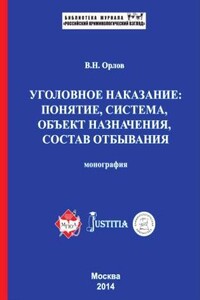
В монографии рассматриваются понятие, система, объект назначения и состав отбывания уголовного наказания. Впервые комплексно проанализированы объективные и субъективные признаки (элементы) состава отбывания уголовного наказания.Для студентов, адъюнктов, аспирантов, преподавателей юридических вузов и факультетов, практикующих юристов, работников уголовно-исполнительной системы и иных правоохранительных органов; может представлять интерес для всех, кто интересуется уголовным наказанием.

Земная цивилизация достигла критического порога, и потеря людьми интереса к космосу лишь вершина айсберга. Первые космические программы имели ясную цель, объявленную Циолковским: расселение человечества по Солнечной системе. Сейчас цель потеряна как для развития космонавтики, так и для человечества в целом. Оно должно сдать экзамен на разумность и обеспечить себе переход на новую ступень развития.(«Техника-молодежи», № 8/2004)

Азию мы называем Азией, а Антарктиду – Антарктидой. Вот Фарерские острова, но нам лучше на Канарские. Слова, известные со школы, звучат, будто музыка: Гренландия и Исландия, Миссури и Ориноко, Босфор и Дарданеллы. С чем и с кем связано то или иное географическое название – кто так назвал, когда и почему? Знать бы! И удивлять других: «Кстати, о Миссисипи…»Эта книга раскрывает многие историко-географические тайны. Рассказы о происхождении названий географических объектов часто оказываются посильнее детективных романов.

Настоящее пособие знакомит учителей физической культуры с нормами санитарно-гигиенического режима, мерами пожарной безопасности на уроках физкультуры. В нем представлены нормативные акты, формы документов, извлечения из методических указаний, правил и инструкций по охране труда, регламентирующие безопасность проведения физкультурно-оздоровительной, учебной и внеклассной работы в образовательных учреждениях; показан порядок и правила проведения инструктажей по мерам безопасности.Пособие предназначено для студентов, преподавателей, учителей физической культуры и школьников.

Эта книга о наших детях, о происшествиях и явлениях, связанных с ними и выходящих за рамки традиционного мировосприятия.Вас, уважаемый читатель, ждут встречи с героями невероятных историй, удивительными людьми, участниками и очевидцами феноменальных событий, необъяснимых с точки зрения логики и «приземленного» мышления.Также вы получите возможность побывать в гостях у известной духовной целительницы Зины Ивановны, побеседовать с ней, вместе проанализировать почерпнутую информацию. Эта необычная женщина будет комментировать те удивительные истории, которые рассказаны на этих страницах.
В книге рассказывается история главного героя, который сталкивается с различными проблемами и препятствиями на протяжении всего своего путешествия. По пути он встречает множество второстепенных персонажей, которые играют важные роли в истории. Благодаря опыту главного героя книга исследует такие темы, как любовь, потеря, надежда и стойкость. По мере того, как главный герой преодолевает свои трудности, он усваивает ценные уроки жизни и растет как личность.
В книге рассказывается история главного героя, который сталкивается с различными проблемами и препятствиями на протяжении всего своего путешествия. По пути он встречает множество второстепенных персонажей, которые играют важные роли в истории. Благодаря опыту главного героя книга исследует такие темы, как любовь, потеря, надежда и стойкость. По мере того, как главный герой преодолевает свои трудности, он усваивает ценные уроки жизни и растет как личность.