Нелокальность - [109]
, edited by Milič Čapek, 3–16. Boston Studies in the Philosophy of Science 22. New York: Springer, 1976.
Cramer, John G. “The Quantum Handshake.” The Alternate View, Analog Science Fiction and Fact, November 1986.
Craps, Ben, Savdeep Sethi, and Erik P. Verlinde. “A Matrix Big Bang.” Journal of High Energy Physics 10, no. 1 (October 2005).
Cushing, James T. “Locality/Separability: Is This Necessarily a Useful Distinction?” PSA: Proceedings of the Biennial Meeting of the Philosophy of Science Association 1994. Vol. 1, Contributed Papers, 107–16. Chicago: University of Chicago Press, 1994.
Quantum Mechanics: Historical Contingency and the Copenhagen Hegemony. Chicago: University of Chicago Press, 1994.
Theory Construction and Selection in Modern Physics: The S Matrix. New York: Cambridge University Press, 1990.
Cushing, James T., and Ernan McMullin, eds. Philosophical Consequences of Quantum Theory: Reflections on Bell’s Theorem. Notre Dame, IN: University of Notre Dame Press, 1989.
Davies, Paul C. W., and J. R. Brown. The Ghost in the Atom: A Discussion of the Mysteries of Quantum Physics. New York: Cambridge University Press, 1986. Reprint, 1993.
Davis, Tamara M., and Charles H. Lineweaver. “Expanding Confusion: Common Misconceptions of Cosmological Horizons and the Superluminal Expansion of the Universe.” Publications of the Astronomical Society of Australia 21, no. 1 (2004): 97–109.
de Haas-Lorentz, Geertruida Luberta. H. A. Lorentz: Impressions of His Life and Work. Amsterdam: North Holland Publishing, 1957.
de Muynck, Willem M. “Can We Escape From Bell’s Conclusion That Quantum Mechanics Describes a Non-Local Reality?” Studies in History and Philosophy of Science Part B 27, no. 3 (September 1996): 315–30.
Descartes, René. Principles of Philosophy. Translated by Valentine Rodger Miller and Reese P. Miller. New York: Springer, 1984.
The Philosophical Writings of Descartes. Vol. 3, The Correspondence. Translated by John Cottingham, Robert Stoothoff, and Dugald Murdoch. New York: Cambridge University Press, 1991.
d’Espagnat, Bernard. “The Quantum Theory and Reality.” Scientific American, November 1979.
DeWitt, Bryce S. “Quantum Mechanics and Reality.” Physics Today 23, no. 9 (September 1970): 155–65.
Dickens, Charles. The Personal History of David Copperfeld. Edited by Trevor Blount, New York: Penguin Classics, 1966.
Dickson, Michael. Quantum Chance and Non-Locality: Probability and Non-Locality in the Interpretations of Quantum Mechanics. Cambridge: Cambridge University Press, 1998.
Dijksterhuis, E. J. The Mechanization of the World Picture: Pythagoras to Newton. Translated by C. Dikshoorn. Prince ton, NJ: Prince ton University Press, 1986.
Dirac, Paul Adrien Maurice. “Classical Theory of Radiating Electrons.” Proceedings of the Royal Society A: Mathematical and Physical Sciences 167, no. 929 (August 5, 1938): 148–69.
“Quantised Singularities in the Electromagnetic Field.” Proceedings of the Royal Society A: Mathematical Physical and Engineering Sciences 133, no. 821 (September 1, 1931): 60–72.
“The Evolution of the Physicist’s Picture of Nature.” Scientific American, May 1963, 45–53.
Dobbs, B. J. T. “Newton’s Alchemy and His Theory of Matter.” Isis 73, no. 4 (December 1982): 511–28.
Doran, Barbara Giusti. “Origins and Consolidation of Field Theory in Nineteenth-Century Britain: From the Mechanical to the Electromagnetic View of Nature.” Historical Studies in the Physical Sciences 6 (1975): 133–260.
Dowker, Fay. “Causal Sets and the Deep Structure of Spacetime.” In One Hundred Years of Relativity: Space-Time Structure; Einstein and Beyond, edited by Abhay Ashtekar, 445–64. Hackensack, NJ: World Scientific, 2005.
Dreyer, Olaf. “The World Is Discrete.” arXiv.org, July 23, 2013.
Duff, Michael J. “The Theory Formerly Known as Strings.” Scientific American, February 1998.
Duncan, Anthony. The Conceptual Framework of Quantum Field Theory. New York: Oxford University Press, 2012.
Earman, John. “Locality, Nonlocality, and Action at a Distance: A Skeptical Review of Some Philosophical Dogmas.” In Kelvin’s Baltimore Lectures and Modern Theoretical Physics: Historical and Philosophical Perspectives, edited by Robert Kargon and Peter Achinstein, 449–90. Cambridge, MA: The MIT Press, 1987.
A Primer on Determinism. Boston: Kluwer Academic Publishers, 1986.
“Recent Work on Time Travel.” In Time’s Arrows Today: Recent Physical and Philosophical Work on the Direction of Time, edited by Steven F. Savitt, 268–310. New York: Cambridge University Press, 1995.
World Enough and Space-Time: Absolute Versus Rational Theories of Space and Time. Cambridge, MA: The MIT Press, 1989.
Easther, Richard, Raphael Flauger, Paul McFadden, and Kostas Skenderis. “Constraining Holographic Inflation with WMAP.” Journal of Cosmology and Astroparticle Physics, no. 9 (September 2011).
Ehlers, Jürgen. “The Nature and Structure of Spacetime.” In The Physicist’s Conception of Nature, edited by Jagdish Mehra, 71–91. Boston: D. Reidel Publishing Company, 1973.
Einstein, Albert. “Autobiographical Notes.” In
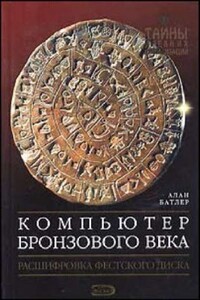
Созданный более 4000 лет назад Фестский диск до сих пор скрывает множество тайн. Этот уникальный археологический артефакт погибшей минойской цивилизации, обнаруженный на острове Крит в начале XX века, является одной из величайших загадок в истории человечества. За годы, прошедшие со дня его находки, многие исследователи пытались расшифровать нанесенные на нем пиктограммы, однако до настоящего времени ни одна из сотен интерпретаций не получила всеобщего признания.Алан Батлер предлагает собственную научно обоснованную версию дешифровки содержимого Фестского диска.

Автором произведенена попытка проследить и систематизировать историю появления НЛО.

В книге рассказывается история главного героя, который сталкивается с различными проблемами и препятствиями на протяжении всего своего путешествия. По пути он встречает множество второстепенных персонажей, которые играют важные роли в истории. Благодаря опыту главного героя книга исследует такие темы, как любовь, потеря, надежда и стойкость. По мере того, как главный герой преодолевает свои трудности, он усваивает ценные уроки жизни и растет как личность.
Описываются дедуктивные, индуктивные и правдоподобные модели, учитывающие особенности человеческих рассуждений. Рассматриваются методы рассуждений, опирающиеся на знания и на особенности человеческого языка. Показано, как подобные рассуждения могут применяться для принятия решений в интеллектуальных системах.Для широкого круга читателей.
В книге рассказывается история главного героя, который сталкивается с различными проблемами и препятствиями на протяжении всего своего путешествия. По пути он встречает множество второстепенных персонажей, которые играют важные роли в истории. Благодаря опыту главного героя книга исследует такие темы, как любовь, потеря, надежда и стойкость. По мере того, как главный герой преодолевает свои трудности, он усваивает ценные уроки жизни и растет как личность.
В книге рассказывается история главного героя, который сталкивается с различными проблемами и препятствиями на протяжении всего своего путешествия. По пути он встречает множество второстепенных персонажей, которые играют важные роли в истории. Благодаря опыту главного героя книга исследует такие темы, как любовь, потеря, надежда и стойкость. По мере того, как главный герой преодолевает свои трудности, он усваивает ценные уроки жизни и растет как личность.